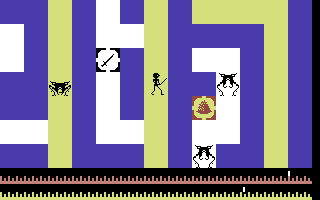
Maziacs is a...maze game created by Don Priestley as a sequel to his Mazogs, which was a ZX81 game. In Maziacs you control a sword-wielding guy who needs to find the treasure at the end of a maze and bring it back to your starting point. Standing in your way are the maziacs, monsters you need to either avoid or kill with your sword, but the twist is that your sword is only good for one fight. After being used, you have to find another sword, or you could gamble on your ability to kill a monster without it but there's a good chance they'll kill you instead. And if you've found the treasure, you can only carry it, so if you need to fight, you need to find a sword, pick it up, kill the monster, then go back and get the treasure. Oh, and you need to find the limited quantities of food to keep yourself going.
The other main feature of the game is the prisoners. You occasionally encounter men chained up in the maze and when you free them, they repay you by giving you directions to the treasure or the starting point if you're lugging the treasure with you. This takes the form of the path lighting up for a brief time.
Graphically, it's a pretty basic game, as expected from a game with ZX81 origins, but the cartoon dust cloud that erupts when you get in a fight is a fun touch.
Maziacs isn't very hard and I cleared the highest difficulty within 20 minutes of first starting the game, but the thing is that it's a score-oriented game that you're meant to replay and it is a fast and fun piece of work.
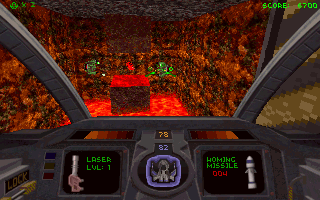
Descent has become oddly obscure for a game that was kind of a big deal in its own time. It's basically Doom but you can fly in any direction, as you control a ship through mines dug throughout the solar system, destroying robots that have run amok with some mysterious virus. It has a bit of a cyberpunk vibe in that you're forced to do this mission by an omnipotent corporation that simply wants its stuff protected - your character is only ever referred to as "material defender".
The game's level design shows no sign of temerity. The creators really embraced the "six degrees of freedom" concept and pretzeled things up as well as they could imagine, so frequent double-checking of the map is a good idea, and figuring the quickest route to the level exit is a necessity since you have a time limit to escape after destroying the main reactor in each level.
The graphics are quite nice, especially when playing the game through the DXX Rebirth source port, and there's a nice selection of weapons from which to select. The game is perhaps a bit more confusing than it needs to be and there is something dry about blasting robots throughout the game's duration. Overall, it's a game that impresses greatly at its outset and then gradually becomes a little tedious by the time it ends.
Turtles (hell yeah, turtles are awesome!) seems like it might be a companion to Konami's Frogger. The cute animal games of 1981. Whereas Frogger was about the frogs trying to get home by crossing the street and the river, in Turtles you control a mama turtle who's trying to save her babies from a bunch of beetles that are infesting a high-rise. How the turtles got up there is left to the imagination.
The way it plays out is that you run around a maze, opening boxes scattered about. Most of the boxes have your babies inside and when you open the box, the baby will climb on your back, at which point you have to take it to the "home" icon that appears in one of the corners of the maze. A couple of the boxes, however, are traps and house extra beetles. Most maze games at the time ripped off Pac-Man and would allow you to eat the enemies after getting a power pellet or something. The way the mama turtle fights back is that she's carrying a selection of bombs she can leave behind her and these bombs will temporarily immobilize a beetle. Bomb refills regularly appear at the maze center (giving you three at a time), so you want to stockpile these things whenever possible because the beetles are very fast and hard to shake once they're on your tail. A limitation of the bombs is that you can only drop one and can't drop another until a beetle runs over it, so make sure you make them count when you decide to drop them.
Turtles is a tough game but addictive and is a solid variation of the maze game formula that was prevalent in its time.
System Shock is often credited as an FPS pioneer, which makes sense because it takes place from a first-person perspective and there is indeed shooting in it, but what it really is is, being a sci-fi successor to the Ultima Underworld games, is a real-time dungeon crawler. You wake up on a space station orbiting Saturn and have explore the environment, battling hostile monsters while SHODAN, the evil AI controlling the station, throws challenges at you like an unsympathetic DM. A major change from the Underworld games was to get rid of NPCs to talk to because the designers felt it broke immersion, so to impart the story to the player they came up with the concept of audio logs left by departed crewmembers. Audio logs have been used so often since Bioshock was a hit that they've become a creaky cliche, but they were very interesting in System Shock because they gave the player the sense of piecing things together like a puzzle and a sense of how to crack Citadel Station's mysteries.
System Shock's actual story is a bit like a cyberpunk take on Die Hard. You're one guy up against a master villain and her minions in an enclosed space, having to scrounge for weapons and resources to foil her schemes while some desperate people on Earth occasionally beam messages to you. A couple of unusual wrinkles are that the hacker you control is amoral and basically caused the whole mess in the first place by scrambling SHODAN's programming, causing her to become self-aware and develop a god complex, and SHODAN herself is a memorable antagonist. Most of the voice acting in the game is amateurish, being handled by non-actors who just worked at Looking Glass, but somehow Terri Brosius, another non-actor (albeit a professional musician) aided by a lot of Max Headroom-like audio mixing, hit on a perfect mix of sultry menace and batshit insanity.
System Shock's controls and user interface are notoriously complex. Again, the game wasn't meant to be an action game, it was a dungeon crawler, so the designers weren't thinking in terms of a smooth, fast, high-octane thrillride like Wolfenstein 3D. They were thinking in terms of player immersion, so they tried to give players as much control over the hero as possible, which meant stuff like allowing you to stand upright, crouch, or lie prone while doing all those things while also leaning left or right while also allowing you to manipulate stuff in the environment or your inventory like you do in RPGs or adventure games while also running, jumping, or climbing all over accessible surfaces. There are positives and negatives to it. The degree to which they succeeded is remarkable for the time and at its best the game is indeed very immersive, but until you fully master the system it does come across as overly fiddly and overwhelming, and even when you do master it the game still makes you feel like you're piloting a human-sized mech rather than a person who simply does what you want. Then there's the cyberspace aspect of the game, which was based on Looking Glass's engine for the Flight Unlimited flight simulator and introduces control challenges of its own. All in all, though, it's a first-rank, highly replayable classic.
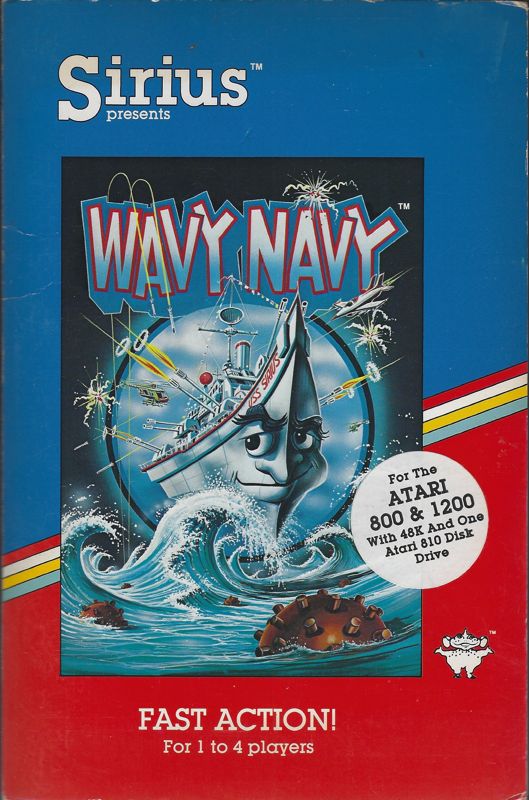
Rodney McAuley's Wavy Navy is arguably the best Galaxian clone that was made. You control a boat that has to shoot down diving planes and helicopters but things are complicated by the fact that you have to move back and forth over a ridiculously undulating sealine. Stuff comes at you from below the water sometimes and you often have to time your movements in accordance with the movement of the waves to avoid what's coming at you. I like Galaxian as well as the next person, but I like Wavy Navy even more (preferably the Apple II version).
I'm not a huge fan of Star Trek beyond the original TV series, so I never watched Deep Space Nine very far beyond the first season or two, but I'm fine with good games based on the shows, and DS9: The Fallen is pretty good.
Made by the Collective, who went on to do a couple of really good Buffy the Vampire Slayer and Indiana Jones games, The Fallen concerns the DS9 crew getting caught up in some Bajoran religious terrorism. An important artifact is stolen from the station and they have to get it back before it's used to do something destructive. Like I said, I didn't watch the show very faithfully so I'm not good for details on how it all works, but the important thing is that it's a well-made third-person action game in which Sisko, Worf, and Kira have to plow through various bad guys. You control one of them throughout the campaign, with Sisko being the primary figure, and then you replay the game with each of the others, which is largely the same but they have access to their own unique stages or portions of common stages. Fortunately, the game is just barely short enough that it all finishes before replaying the same stuff gets tedious.
It's mostly standard TPS stuff, with a little bit of platforming, but at least you don't have to slowly push any very large blocks around, which was a problem for such games around that time. There are rare occasions where you'll face enemies with shields that need to be bypassed by scanning them with the tricorder to determine the shield frequency and then tuning the phaser to that frequency. Amusingly, the phasers are all apparently set to kill only. Worf's default weapon is that Klingon blade he liked to keep around. DS9 crew doesn't mess around.
Between levels you can walk around the station and chat with the supporting cast. Everyone is voiced by the original actors, except for Sisko and O'Brien. The graphics aren't astounding but they're fine in terms of capturing how the series looked and keeping all the action clear and easy to follow.
The first game released by Ultimate Play the Game, later to be known as Rare. It's a simple but compulsively playable shooting game. You fly around the screen, picking up pieces of your spaceship, assembling them, then filling it with fuel, shooting enemies the whole time. After the first level, you just have to pick up the fuel, but every few levels you have to build a new spaceship. It's very smooth and fast-moving.
If there's a major downside to it, it's just that the layout of the screen never changes, with the three platforms always being in the same positions.
After the Ultima Underworld games and System Shock, and before Thief and System Shock 2, Looking Glass released the now somewhat obscure Terra Nova, a military sci-fi game about soldiers who fight in Starship Troopers-like powered armor.
In the future, humans colonized the solar system, but Earth fell under an authoritarian global government, the Hegemony, so some of the people living further out decided to flee to the Alpha Centauri system to live freely. Which took the form of separating into clans that each did things their own way, but at least they weren't under the Hegemony's thumb. Then the Hegemony comes after them and a war breaks out and your character (Nikola ap Io) is the new commander of...Strike Force Centauri.
It's been said that everyone around Origin in the 90s had Wing Commander fever and this game shows it in a big way. There are FMV sequences intended to flesh out the story and characters that somehow look cheap yet simultaneously were apparently so expensive to film that they compromised the game's budget. The scenes are kind of endearing in how low-budget they are, and the characters come across as a bit too high-strung and melodramatic for being such high-level operatives (something Team America: World Police parodies so well), but the traitor subplot is kind of interesting while it lasts. Mostly, the story is just a means to provide some context for the kinds of missions you're assigned.
In terms of how it plays, it's a lot like System Shock. System Shock's biggest issue is that its controls and interface are so complex that you feel more like you're controlling a human-sized mech instead of a person, but a system like that transferred to a game in which you're actually controlling a human-sized mech makes it make sense. You click on sub-systems like weapons, communications, and damage status, select targets in the world view, and then fire on those targets while your suit auto-aims at what you've selected. It's actually a very fast game compared to many other vehicular sims and missions often take less than 5 minutes to complete.
It's fun to play and has just the right amount of complexity. The AI for squadmates is mostly pretty good as they carry their weight in fights but still need your help to succeed and they'll make good decisions in terms of picking targets and moving around. Looking Glass's expertise in immersive gameplay shows out in how you have the freedom to accomplish objectives as you see best. You can charge in blasting, but sneaking and keeping things at a distance is usually a good option, too. The graphics are quite decent for their time but resolution is sadly very limited - it would help the game be more attractive to modern players if there was a way to increase it beyond 320x400.
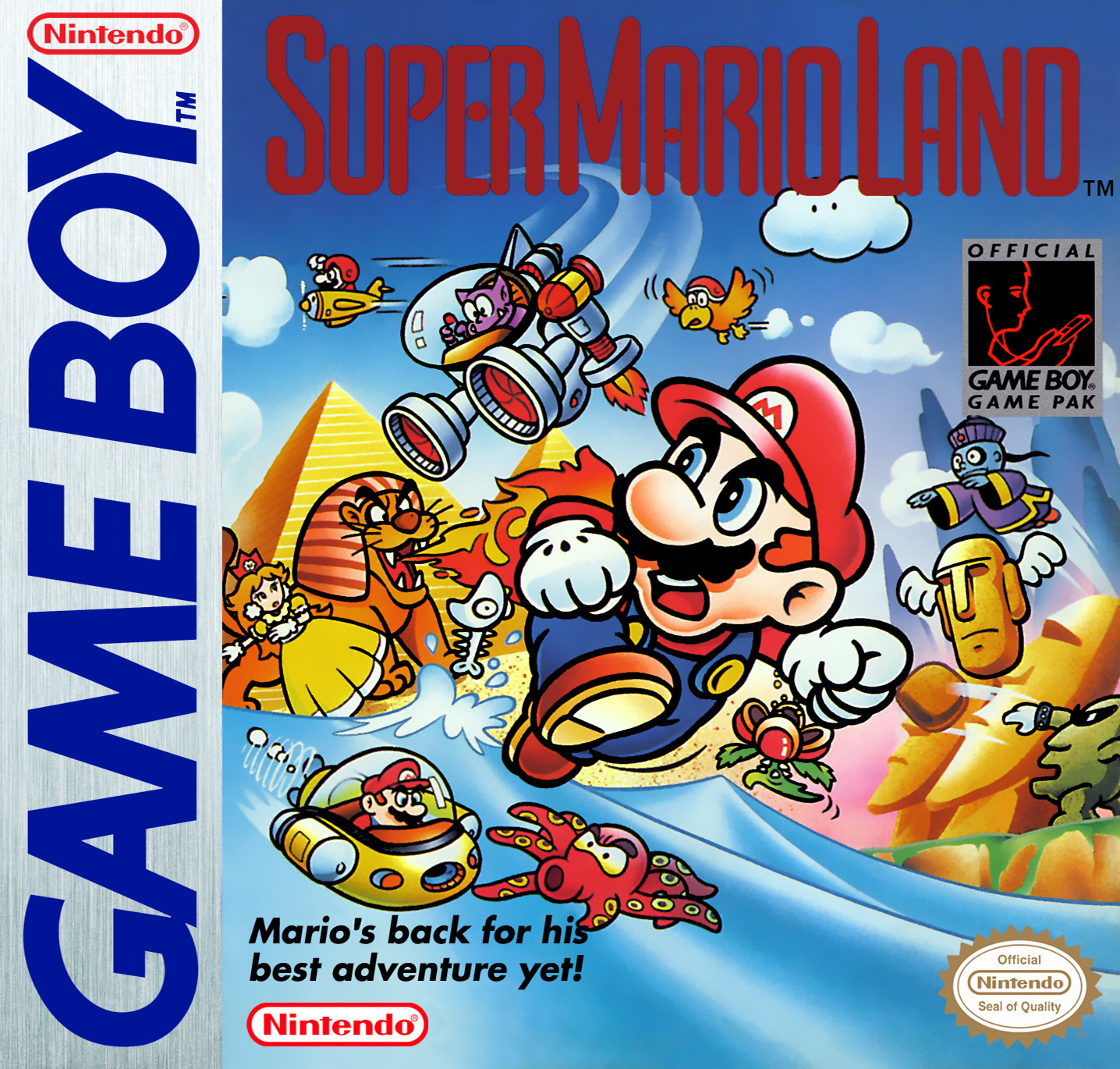
The Gameboy take on Super Mario, overseen by Gunpei Yokoi instead of Shigeru Miyamoto. It's a perfectly serviceable Mario game, although the shift in director and the much smaller screen makes it feel a bit off compared to the mainline games. Mario's block-breaking is slightly different - more straight over his head than his fist - and the jumping physics are a tad more exaggerated. And the fireball throwing works differently because it ricochets off surfaces like a Breakout game, so more care needs to be taken in aiming.
Compared to the pure delirious fantasy of the NES games, this one goes for more of a world tour vibe. For instance, there's an Egyptian level with sphinxes attacking you and a level in which you're beset by Chinese jiangshi/hopping vampires. Horizontal shooting stages replace the underwater levels from the original game. It's quite short and ends just when it feels like the game is really getting going. It's nothing amazing but at the time games of this quality helped resolve a lot of real anxiety about the viability of the Gameboy.
Flashback was a pretty big deal in its time. It had the rotoscoped animation that made Prince of Persia stand out so much, but with shooting instead of swordplay, and a story that was like every major sci-fi movie of the 80s thrown in a blender. Total Recall, The Terminator, The Running Man, They Live, Robocop, Alien... That kind of cinematic approach was still novel at the time.
Cinematic platformers aren't a well-appreciated genre now because their emphasis on weighty, fragile characters that require a more measured, patient approach to gameplay is off-putting to players that just want to jump in and go Super Mario everywhere. But if you can get down with the style, it can be rewarding to persevere through the game, although Flashback also has some ridiculously frustrating combat-heavy sections that seem to have been added mostly to stretch out the playing time because it would otherwise be fairly easy. It's certainly a game that's more about atmosphere than anything else.
Krull the movie was a glossy attempt at a space-fantasy to get in on that rich Star Wars action, with a swashbuckling hero having to rescue his bride from The Beast and his army of faceless Slayers. It had a pretty good cast of people who got famous for doing other things later, and some interesting production design with vivid locations, good special effects, and suitably revolting villains. It even had some cool direction, such as how Peter Yates never really gives the audience a full, clear shot of what the Beast actually looks like, but instead you merely glimpse fragments of him through a haze. But one of the biggest talking points about the movie (to whatever extent people actually talked about it) is that the Glaive, a sort of magical boomerang with switchblades protruding from its five extensions, was an awesome weapon for the Ken Marshall to wield and that it was utterly baffling that the movie never really let him use it. He's constantly told he'll know the right time to use it, even as his friends are mowed down in combat, and then when he does finally use it he just sort of cuts through a wall with it and then a couple of minutes later it gets stuck, at which point he gets an especially cheesy variation of "the power was within you all along!" and the Glaive is left behind.
So the arcade game based on the movie is an almost immediate improvement because you use the Glaive in every level beyond the opening. The game takes a lot of liberties. The first level is reasonably faithful to the film in that you have to run around a mountain grabbing the pieces of the Glaive while dodging boulders careening down the slope. In the movie, he runs up the mountain, dodges a few rocks, and then finds the Glaive in a cave pool.
From level 2 onward, the game becomes a twin-stick shooter with varying objectives. In the second level, you run around a swamp and assemble men for your army while using the Glaive to dispatch Slayers. There is a swamp in the movie, and hero does have to build an army for himself, so this does sort of track. Level 3 sees you running around a rocky labyrinth, rescuing your men while continuing to battle the Slayers, but when you pick up a soldier a hexagon will start meandering around the screen, so you have to essentially place the men inside the hexagon and once you've rescued as many as possible, the level ends. This level seems to be referring to the part near the film climax in which the heroes storm the Black Fortress of the Beast. Level 4 wanders completely away from the movie in that your men are now trapped inside a giant hexagon prison and you need to use the Glaive to break its walls down, but the walls flash color and you can only break a layer when it turns black, and you have to break it open while Slayers attack you. Level 5 is the final confrontation with the Beast, in which you fend off his fireball attacks with the Glaive while trying to reach Princess Lyssa at the top of the screen. Rescuing her causes the Beast to flee, your men celebrate with you, and the game restarts at a higher difficulty.
Interestingly, one of the film's sections that would seem most ripe for a video game adaptation, in which Freddie Jones has to climb across the web of a giant spider while evading the spider, isn't touched. Perhaps the designers brainstormed something and had to scrap it.
Krull was designed by Matt Householder for Gottlieb. Gottlieb, probably best known for Q*Bert, made some very attractive games in its time, with clear graphics and particularly rich, crunchy sound and music and Krull holds up quite well.
Designed by Malcolm Evans (3D Monster Maze, Escape), Trashman is one of those odd cases of turning a job into a game and somehow making it fun. You control a garbage collector and have to empty a street's trashcans before a time limit runs out. The truck idles up the street a little bit at a time, so you have to rush to the can, taking care to not step on the grass because doing so will rob you of a "tip" and might even cause a dog to chase you, pick up the can, bring it to the truck to empty it, then place it exactly where you found it. If you do everything right, the homeowner will call you inside for a moment with some amusing dialogue and you'll get a bonus in time.
The biggest threat in the game, though, is simply trying to cross the street without getting run over by speeding traffic. Getting run over is an immediate game over. After a couple of levels, you have to worry about getting run over by cyclists on the sidewalks, too.
It's pretty nice-looking as Spectrum games go. It keeps things simple and clear with minimal color clashing. Sound effects are sparse, but the controls handle well enough, just "sticky" enough that you usually won't accidentally oversteer into the grass.
One of the great things about Time Pilot is the sense of power your ship has. You're planted at the center of the screen and can turn in every direction, spraying bullets almost as fast as you can hit the button, unlike a lot of shooters from the period that would limit you to one to three shots at a time before you had to wait for the shots to either make contact with an enemy or leave the screen. So you just have this great sense of being able to tear through entire air forces like it's nothing, although the game of course gets more challenging as you go farther into the future and enemies become more advanced, more maneuverable and sending more homing missiles at you.
It's also a very nice-looking and sounding game. Colorful without being garish, flying behind parallax-scrolling clouds in the sky, clearly drawn enemies, and punchy impacts.
Pippols is a vertical shoot-em-up in which you control a guy trying to retrieve a holy ("holly") gem located at the end of a...I suppose you could call it a hedge maze of some sort. As you scroll up, enemies charge you from above and below, and you can only change your lane by hopping through gaps in the vegetation, but many of your enemies can hop over when they want. So a major part of the challenge is to know when to change to a different row so that you're not caught by an enemy while in mid-hop, especially since your character is relatively tall and an easier target to hit. You also need to be careful of dead-ends in the maze.
There are branching stages that you choose after completing one stage, and when you get the gem at the end, you have to go backwards (i.e., it becomes a downward scrolling game) through all the stages again. There are some power-ups you can find, such as shoes that let you jump over the plants
Konami was in its peak years when making this one. They used some tricks to get around the MSX's jagged scrolling problems, the graphics are clear and have a storybook charm, the music is great, and the game is easy to just jump right into but deceptively challenging.
Frogger II: Threeedeep! is an American home sequel, published by Parker Brothers, to Konami's original. Mobygames credits Matt Lintlop and Henry Spragens for the game, with this Atari computer version credited to Larry Gelberg, sole credits for all.
The Threeedeep subtitle refers to how the frogs now need to cross and find homes in three screens of action instead of just one. The first screen is underwater and the frogs have to avoid predatory fish (but can safely cross over non-toothy fish) to get inside floating logs while the current pulls at them a little. Screen two is similar to the water portion of the original game, in which the frogs have to hop across stuff on the surface of the water and snag ahold of a life preserver being dragged by a boat. Screen 3 takes place in the sky and the frogs need to hitch rides with birds to find homes in the clouds.
Underwater
In the clouds
An interesting design choice is that navigating all the way to the end of one of the screens and getting the frogs in their berths doesn't trigger a transition to the next screen. Instead the player needs to figure out how to get to the next screen and manually go there and a major consideration is in what order the screens should be tackled. It might make more sense to go for the clouds first and get the farthest destinations settled before handling things closer to home. To get to screen 2, you simply need to hop onto one of the logs at the end of the first. Screen 3 can be accessed by hopping onto the back of a mother goose looking over her babies as they swim across screen 2.
The graphics are quite nice, the music is jaunty, and the game feels in most ways like a proper sequel to the original, keeping the basic concept and controls the same but expanding on it in reasonable ways. But I do feel a sense of tedium that sets in while having to go through all three screens with each life. If you die on screen 3, you're forced to run through the first and second screens to get back there again. The first screen in particular gets really tiring to redo whenever you lose a life.