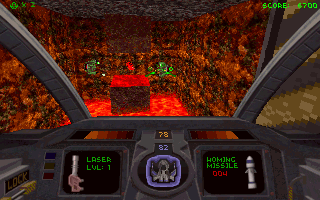
Descent has become oddly obscure for a game that was kind of a big deal in its own time. It's basically Doom but you can fly in any direction, as you control a ship through mines dug throughout the solar system, destroying robots that have run amok with some mysterious virus. It has a bit of a cyberpunk vibe in that you're forced to do this mission by an omnipotent corporation that simply wants its stuff protected - your character is only ever referred to as "material defender".
The game's level design shows no sign of temerity. The creators really embraced the "six degrees of freedom" concept and pretzeled things up as well as they could imagine, so frequent double-checking of the map is a good idea, and figuring the quickest route to the level exit is a necessity since you have a time limit to escape after destroying the main reactor in each level.
The graphics are quite nice, especially when playing the game through the DXX Rebirth source port, and there's a nice selection of weapons from which to select. The game is perhaps a bit more confusing than it needs to be and there is something dry about blasting robots throughout the game's duration. Overall, it's a game that impresses greatly at its outset and then gradually becomes a little tedious by the time it ends.
Turtles (hell yeah, turtles are awesome!) seems like it might be a companion to Konami's Frogger. The cute animal games of 1981. Whereas Frogger was about the frogs trying to get home by crossing the street and the river, in Turtles you control a mama turtle who's trying to save her babies from a bunch of beetles that are infesting a high-rise. How the turtles got up there is left to the imagination.
The way it plays out is that you run around a maze, opening boxes scattered about. Most of the boxes have your babies inside and when you open the box, the baby will climb on your back, at which point you have to take it to the "home" icon that appears in one of the corners of the maze. A couple of the boxes, however, are traps and house extra beetles. Most maze games at the time ripped off Pac-Man and would allow you to eat the enemies after getting a power pellet or something. The way the mama turtle fights back is that she's carrying a selection of bombs she can leave behind her and these bombs will temporarily immobilize a beetle. Bomb refills regularly appear at the maze center (giving you three at a time), so you want to stockpile these things whenever possible because the beetles are very fast and hard to shake once they're on your tail. A limitation of the bombs is that you can only drop one and can't drop another until a beetle runs over it, so make sure you make them count when you decide to drop them.
Turtles is a tough game but addictive and is a solid variation of the maze game formula that was prevalent in its time.
System Shock is often credited as an FPS pioneer, which makes sense because it takes place from a first-person perspective and there is indeed shooting in it, but what it really is is, being a sci-fi successor to the Ultima Underworld games, is a real-time dungeon crawler. You wake up on a space station orbiting Saturn and have explore the environment, battling hostile monsters while SHODAN, the evil AI controlling the station, throws challenges at you like an unsympathetic DM. A major change from the Underworld games was to get rid of NPCs to talk to because the designers felt it broke immersion, so to impart the story to the player they came up with the concept of audio logs left by departed crewmembers. Audio logs have been used so often since Bioshock was a hit that they've become a creaky cliche, but they were very interesting in System Shock because they gave the player the sense of piecing things together like a puzzle and a sense of how to crack Citadel Station's mysteries.
System Shock's actual story is a bit like a cyberpunk take on Die Hard. You're one guy up against a master villain and her minions in an enclosed space, having to scrounge for weapons and resources to foil her schemes while some desperate people on Earth occasionally beam messages to you. A couple of unusual wrinkles are that the hacker you control is amoral and basically caused the whole mess in the first place by scrambling SHODAN's programming, causing her to become self-aware and develop a god complex, and SHODAN herself is a memorable antagonist. Most of the voice acting in the game is amateurish, being handled by non-actors who just worked at Looking Glass, but somehow Terri Brosius, another non-actor (albeit a professional musician) aided by a lot of Max Headroom-like audio mixing, hit on a perfect mix of sultry menace and batshit insanity.
System Shock's controls and user interface are notoriously complex. Again, the game wasn't meant to be an action game, it was a dungeon crawler, so the designers weren't thinking in terms of a smooth, fast, high-octane thrillride like Wolfenstein 3D. They were thinking in terms of player immersion, so they tried to give players as much control over the hero as possible, which meant stuff like allowing you to stand upright, crouch, or lie prone while doing all those things while also leaning left or right while also allowing you to manipulate stuff in the environment or your inventory like you do in RPGs or adventure games while also running, jumping, or climbing all over accessible surfaces. There are positives and negatives to it. The degree to which they succeeded is remarkable for the time and at its best the game is indeed very immersive, but until you fully master the system it does come across as overly fiddly and overwhelming, and even when you do master it the game still makes you feel like you're piloting a human-sized mech rather than a person who simply does what you want. Then there's the cyberspace aspect of the game, which was based on Looking Glass's engine for the Flight Unlimited flight simulator and introduces control challenges of its own. All in all, though, it's a first-rank, highly replayable classic.
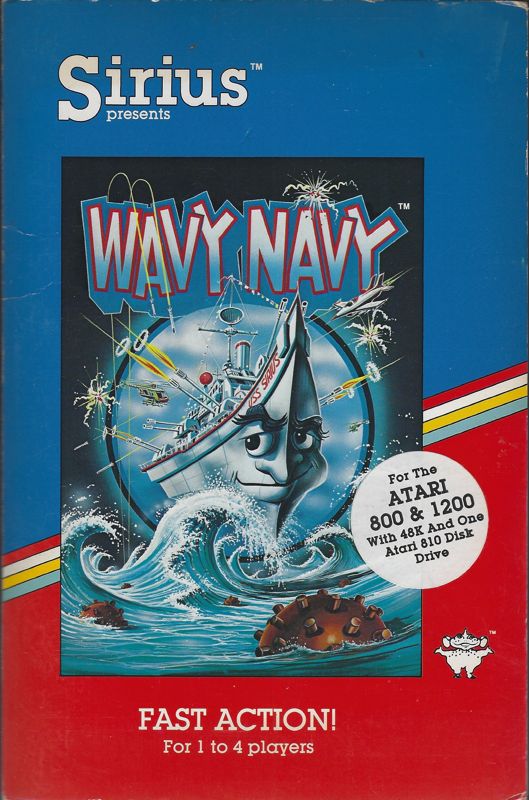
Rodney McAuley's Wavy Navy is arguably the best Galaxian clone that was made. You control a boat that has to shoot down diving planes and helicopters but things are complicated by the fact that you have to move back and forth over a ridiculously undulating sealine. Stuff comes at you from below the water sometimes and you often have to time your movements in accordance with the movement of the waves to avoid what's coming at you. I like Galaxian as well as the next person, but I like Wavy Navy even more (preferably the Apple II version).
I'm not a huge fan of Star Trek beyond the original TV series, so I never watched Deep Space Nine very far beyond the first season or two, but I'm fine with good games based on the shows, and DS9: The Fallen is pretty good.
Made by the Collective, who went on to do a couple of really good Buffy the Vampire Slayer and Indiana Jones games, The Fallen concerns the DS9 crew getting caught up in some Bajoran religious terrorism. An important artifact is stolen from the station and they have to get it back before it's used to do something destructive. Like I said, I didn't watch the show very faithfully so I'm not good for details on how it all works, but the important thing is that it's a well-made third-person action game in which Sisko, Worf, and Kira have to plow through various bad guys. You control one of them throughout the campaign, with Sisko being the primary figure, and then you replay the game with each of the others, which is largely the same but they have access to their own unique stages or portions of common stages. Fortunately, the game is just barely short enough that it all finishes before replaying the same stuff gets tedious.
It's mostly standard TPS stuff, with a little bit of platforming, but at least you don't have to slowly push any very large blocks around, which was a problem for such games around that time. There are rare occasions where you'll face enemies with shields that need to be bypassed by scanning them with the tricorder to determine the shield frequency and then tuning the phaser to that frequency. Amusingly, the phasers are all apparently set to kill only. Worf's default weapon is that Klingon blade he liked to keep around. DS9 crew doesn't mess around.
Between levels you can walk around the station and chat with the supporting cast. Everyone is voiced by the original actors, except for Sisko and O'Brien. The graphics aren't astounding but they're fine in terms of capturing how the series looked and keeping all the action clear and easy to follow.
The first game released by Ultimate Play the Game, later to be known as Rare. It's a simple but compulsively playable shooting game. You fly around the screen, picking up pieces of your spaceship, assembling them, then filling it with fuel, shooting enemies the whole time. After the first level, you just have to pick up the fuel, but every few levels you have to build a new spaceship. It's very smooth and fast-moving.
If there's a major downside to it, it's just that the layout of the screen never changes, with the three platforms always being in the same positions.
After the Ultima Underworld games and System Shock, and before Thief and System Shock 2, Looking Glass released the now somewhat obscure Terra Nova, a military sci-fi game about soldiers who fight in Starship Troopers-like powered armor.
In the future, humans colonized the solar system, but Earth fell under an authoritarian global government, the Hegemony, so some of the people living further out decided to flee to the Alpha Centauri system to live freely. Which took the form of separating into clans that each did things their own way, but at least they weren't under the Hegemony's thumb. Then the Hegemony comes after them and a war breaks out and your character (Nikola ap Io) is the new commander of...Strike Force Centauri.
It's been said that everyone around Origin in the 90s had Wing Commander fever and this game shows it in a big way. There are FMV sequences intended to flesh out the story and characters that somehow look cheap yet simultaneously were apparently so expensive to film that they compromised the game's budget. The scenes are kind of endearing in how low-budget they are, and the characters come across as a bit too high-strung and melodramatic for being such high-level operatives (something Team America: World Police parodies so well), but the traitor subplot is kind of interesting while it lasts. Mostly, the story is just a means to provide some context for the kinds of missions you're assigned.
In terms of how it plays, it's a lot like System Shock. System Shock's biggest issue is that its controls and interface are so complex that you feel more like you're controlling a human-sized mech instead of a person, but a system like that transferred to a game in which you're actually controlling a human-sized mech makes it make sense. You click on sub-systems like weapons, communications, and damage status, select targets in the world view, and then fire on those targets while your suit auto-aims at what you've selected. It's actually a very fast game compared to many other vehicular sims and missions often take less than 5 minutes to complete.
It's fun to play and has just the right amount of complexity. The AI for squadmates is mostly pretty good as they carry their weight in fights but still need your help to succeed and they'll make good decisions in terms of picking targets and moving around. Looking Glass's expertise in immersive gameplay shows out in how you have the freedom to accomplish objectives as you see best. You can charge in blasting, but sneaking and keeping things at a distance is usually a good option, too. The graphics are quite decent for their time but resolution is sadly very limited - it would help the game be more attractive to modern players if there was a way to increase it beyond 320x400.